
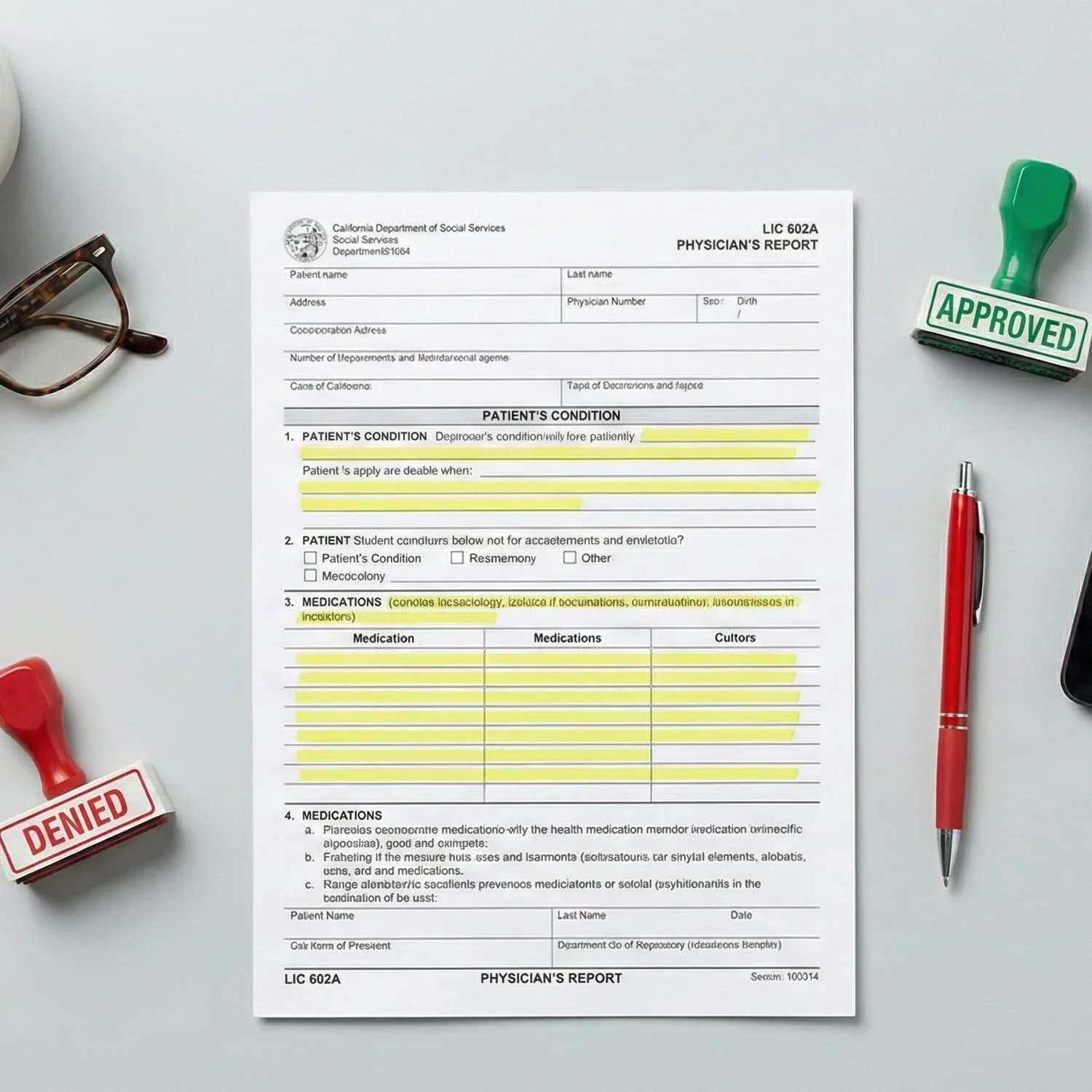
Image generated with AI for illustrative purposes only.
For RCFE (Residential Care Facility for the Elderly) administrators, the LIC 602A is the most critical clinical document in the pre-admission process. It serves as the primary tool to ensure that the facility’s care capabilities align with the resident's medical needs.
Drawing on clinical standards from the CDC, NIH, and Mayo Clinic, here is a 5-minute checklist for a rigorous analysis of the Physician’s Report.
1. Infection Control: TB Clearance
The CDC (Centers for Disease Control and Prevention) emphasizes that TB screening is a fundamental safety requirement for congregate living settings to prevent respiratory outbreaks.
Key items to check: A documented negative tb skin test (PPD) or a clear chest x-ray.
Obtaining Records: Families often search for "tb clearance near me" to find local clinics that can provide the necessary documentation for the TB Clearance section of the form.
The Verdict: If the LIC 602A lacks "Clearance of infectious TB," the admission process must pause to ensure the safety of the existing resident population.
2. Cognitive Health & Safety Risk
Research from the NIH (National Institutes of Health) indicates that a resident's cognitive status and mental health status require specific environmental safeguards to manage risks like wandering or disorientation.
Key items to check: Whether the physician indicates a diagnosis of Alzheimer’s or other dementias.
The Verdict: If a facility does not have a Dementia Waiver on its license, it cannot legally admit the resident. The NIH suggests that specialized environments are essential for preventing elopement and ensuring safety.
3. Clinical "Red Zones": Prohibited Conditions
Certain medical conditions are classified as "prohibited" because they require a level of monitoring typically found in a hospital setting.
Key items to check: Any mention of Stage 3 or 4 pressure ulcers (bedsores).
Clinical Insight: The Mayo Clinic identifies Stage 3 and 4 ulcers as severe injuries extending into deep tissue and muscle, which carry a high risk of systemic infection.
The Verdict: Unless the facility has a specific waiver for hospice or home health, these conditions are clinical grounds for denial of admission.
4. Physical Mobility & Evacuation Status
A facility’s safety plan and fire clearance are built entirely around the ambulatory status of its residents.
Key items to check: Whether the resident is marked as "Ambulatory," "Non-Ambulatory," or "Bedridden."
The Verdict: If a resident is marked "Non-Ambulatory" but the facility's fire clearance is limited to ambulatory individuals, the admission cannot proceed. Residents must be able to exit the building in an emergency with the level of assistance the license allows.
5. Care Alignment & Physician Recommendation
The Kaiser Permanente Division of Research highlights that the success of a care transition depends on the accurate matching of a resident’s functional status to the facility's staffing.
The "Bottom Line" Check: Whether the physician checked "YES" to the question: "Is the individual appropriate for a Residential Care Facility for the Elderly?"
The Verdict: If the physician’s notes describe a need for "total care" or "continuous clinical monitoring" while checking "Yes," there is a discrepancy. Following the Kaiser Permanente research model, clinical safety must take precedence over a simple checkbox. If the needs exceed the staff's training, the admission is considered unsafe.
Quick Decision Matrix for LIC 602A
| Finding on Form | Action | Clinical / Regulatory Basis |
|---|---|---|
| No TB Clearance | Postpone | CDC Public Health Standards |
| Stage 3/4 Pressure Ulcers | Deny | Mayo Clinic Infection Risk Protocols |
| Dementia (No Waiver) | Deny | NIH Safety and Supervision Standards |
| Non-Ambulatory (No Clearance) | Deny | Fire Safety & Evacuation Regulations |
| Total Clinical Dependence | Deny | Clinical Level of Care Alignment |
A rapid analysis of the LIC 602A is the best defense against a "resident-facility mismatch." As Kaiser Permanente research suggests, the quality of the initial clinical assessment is the most accurate predictor of a resident's long-term health stability in a new environment.
The LIC 602A must be signed and dated within 6 months of the admission date to be considered valid under California regulations.
References
CDC (Centers for Disease Control and Prevention) — Tuberculosis (TB) Screening and Testing of Health Care Personnel and Congregate Living Settings.
NIH (National Institute on Aging / NIH) — Managing Long-term Care for People with Dementia: Safety and Behavior Risks.
Mayo Clinic — Bedsores (Pressure Ulcers): Symptoms, Stages, and Infection Risks.
Kaiser Permanente Division of Research — Optimizing Care Transitions: Research on Patient Safety and Staffing Alignment.
CMS (Centers for Medicare & Medicaid Services) — Clinical Standards for Levels of Care and Long-Term Care Assessment.
