
RCFE Training Requirements: How Many Hours California Actually Demands
Table of Content
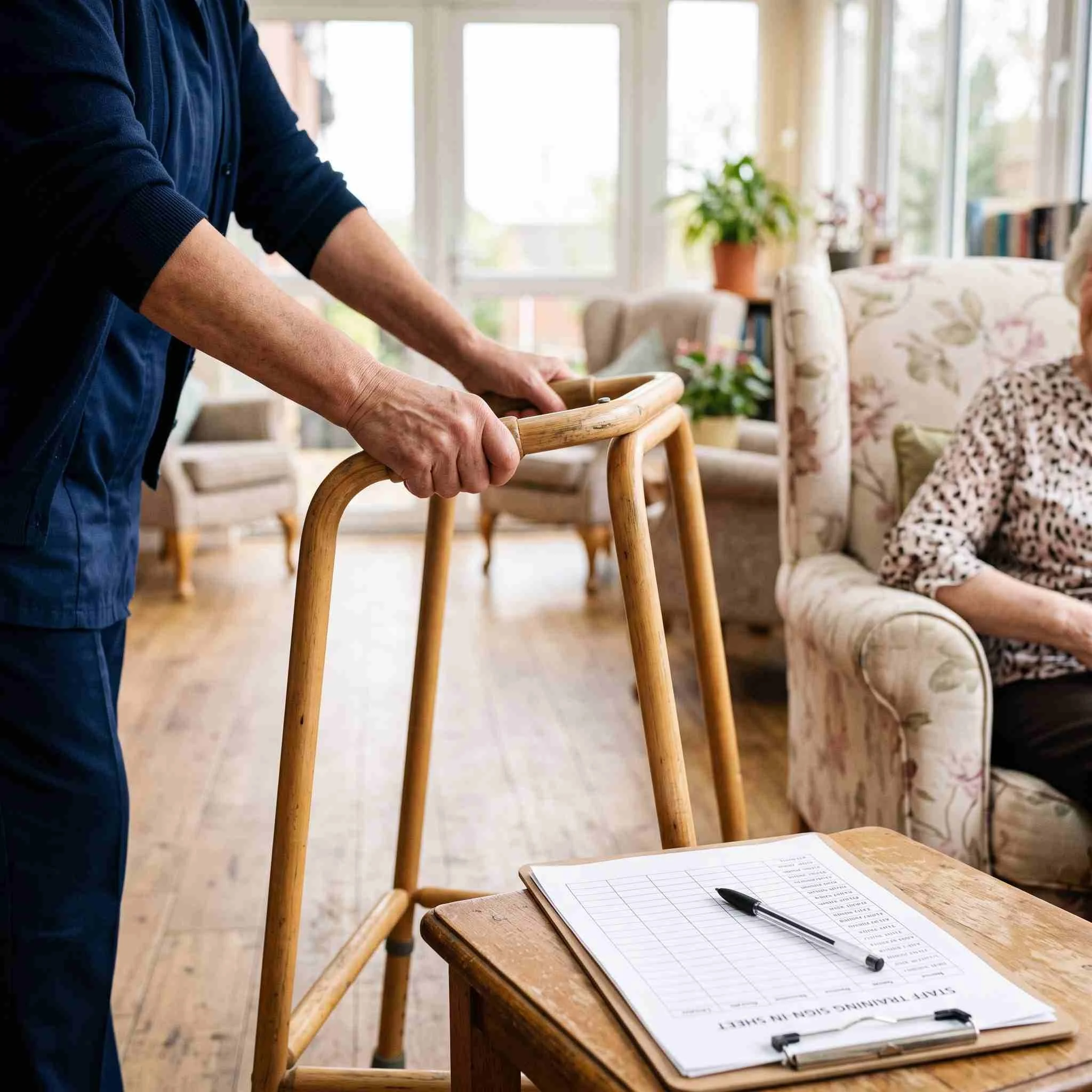
California requires 40 hours of initial training for RCFE direct care staff and 20 more hours every year after that. Dementia training is written into both numbers.
Those hours are the legal floor rather than a description of what good care looks like. A home can meet every requirement on paper and still feel thin on the floor at seven in the evening, which is exactly what families sense when they visit.
Knowing the actual numbers gives you something concrete to ask about on a tour. A question like how many of your caregivers have finished all 40 hours gets a far more useful answer than asking whether the staff are well trained, because one has a number attached and the other does not.
RCFE Training Requirements at a Glance
The rules are split into two tracks: one for the people who help residents day to day, and one for the administrator who runs the home. Both tracks carry a required dementia component, which is a relatively recent addition to California law.
| Who and When | What California Requires |
|---|---|
| Direct care staff, first 40 hours | 20 hours before working independently with residents, plus 20 more within the first four weeks |
| Dementia training, initial | 12 hours in total: 6 before working independently and 6 within the first month |
| Direct care staff, every year | 20 hours, including 8 on dementia care and 4 on postural supports, restricted health conditions, and hospice |
| Administrator, to get certified | 80 hours of coursework with at least 60 hours of instruction, followed by a written exam |
| Administrator, to stay certified | 40 hours every two years, at least 8 of them on Alzheimer's disease and other dementias |
Read that table as a minimum and nothing more. Nothing in it says how many of those hours were hands-on, who taught them, or whether the caregiver assigned to your parents finished them last month or three years ago. Those details are what separate two homes with identical paperwork.
What Do the First 40 Hours of Caregiver Training Cover?
They are split deliberately, so that nobody is left alone with residents on day one. California Health and Safety Code section 1569.625 sets 40 hours of initial training for staff who assist residents with activities of daily living, divided into two blocks (Health and Safety Code section 1569.625).
The 20 Hours Before Anyone Works Alone
The first block has to be finished before a caregiver works independently with residents. Inside it sits 6 hours specifically on dementia care and 4 hours on postural supports, restricted health conditions, and hospice, which are the situations that go wrong fastest when someone improvises.
That ordering is the part worth appreciating. Somebody who has never worked in care before cannot legally be handed a hall of residents on their first shift, however short-staffed the building happens to be that week. The sequence exists precisely because short weeks are common.
The 20 Hours After That
The second block must be completed within the first four weeks of employment. It includes another 6 hours of dementia care and 16 hours of hands-on training, which is the closest the statute comes to requiring practice rather than slides.
Ask a home how that hands-on portion is delivered. Shadowing an experienced caregiver on a real shift and clicking through a video course both technically count, and the difference between them shows up in how a new hire handles a difficult transfer.
How Much Dementia Training Is Required in California?
Twelve hours up front and eight hours a year after that. Health and Safety Code section 1569.626 requires direct care staff in elderly residential care to complete 12 hours of dementia instruction, 6 before working independently and 6 within the first month, plus eight hours of in-service training per year developed with dementia care experts (Health and Safety Code section 1569.626).
Twelve hours is not a small number in a field where some states require none. It is also not enough to make someone skilled at dementia care, which is why the difference between homes with identical paperwork can be so visible during a tour.
What that skill looks like in practice is easier to recognize than to define. A description of what a strong memory care program actually looks like gives you concrete things to watch for, from how activities are built to how staff respond when someone is upset.
Behavior is where training shows itself first. If a resident wanders because of dementia, the home has to be able to describe its plan for that specific risk, and the plan has to match what the physician documented before the move-in rather than quietly contradict it.
What Training Does the RCFE Administrator Need?
Far more than the care staff, and for good reason. Health and Safety Code section 1569.616 requires a minimum of 80 hours of coursework, including at least 60 hours of instruction, followed by an exam of at least 100 questions taken within 60 days of finishing the program (Health and Safety Code section 1569.616).
Keeping the certificate takes 40 hours of continuing education every two years, of which at least 8 must cover dementia. No more than half of those hours may be self-paced, so a portion has to be live instruction rather than recorded modules watched at midnight.
The administrator sets the tone for everything below them. They decide how much training happens beyond the minimum, how new staff are paired with experienced ones, and whether a caregiver who is struggling gets coaching or simply a different shift. Ask how long the current one has held the job.
Does California Require a Staff-to-Resident Ratio?
No fixed number exists, and this surprises most families. Health and Safety Code section 1569.618 requires an administrator, facility manager, or designated substitute on the premises 24 hours a day, a sufficient number of staff to meet residents' needs, and at least one person trained in CPR and first aid on duty at all times (Health and Safety Code section 1569.618).
Sufficient is the operative word, and it is deliberately flexible. A home with eight independent residents and a home with eight residents who need two-person transfers are held to the same standard phrased the same way, even though the staffing they need is nothing alike.
This is why asking about numbers at specific hours beats asking about ratios. How many caregivers are awake and on the floor at 3 a.m. is a factual question with a factual answer, and it reveals more than any policy document.
Staffing also shapes what happens when a resident declines. A home that cannot meet a new level of need may start a change of condition and discharge conversation rather than add staff, which is a risk worth understanding before you sign anything.
Why Do Families Still Feel the Staff Are Undertrained?
Because the hours are a floor and the labor market is tight. According to the Alzheimer's Association (2026), nearly 800,000 additional direct care workers will be needed between 2024 and 2034, with annual turnover estimated at 79% in home care and 99% for nursing assistants in nursing homes (Alzheimer's Disease Facts and Figures).
Turnover at that level resets a building's accumulated skill constantly. A home can be fully compliant while most of its caregivers are still inside their first year, and experience is usually the thing families are sensing when they cannot quite name what feels wrong on a tour.
Compliance also measures completion rather than competence. The record shows a caregiver sat through 12 hours of dementia instruction; it does not show whether they can calm someone who no longer recognizes their own room at two in the morning.
None of this means the requirements are meaningless. It means the paperwork answers one question and your own eyes answer a different one, and families who weigh both tend to choose better than those who lean entirely on a brochure or entirely on a gut feeling.
How Can You Check a Home's Staffing and Training Before You Commit?
Start with the public record, then verify it in person. CANHR (2025) points families to the Community Care Licensing facility search, which carries inspection reports created after April 16, 2015 and complaint investigation reports approved after January 11, 2016 (Searching for a Residential Care Facility for the Elderly (RCFE)).
Those reports name what inspectors actually found on site, which is far more useful than any brochure. A single deficiency tells you little on its own, while the same citation repeating across several years is a pattern worth asking the administrator about directly. Then ask questions that have numbers in them:
How many caregivers are on the floor during the day, the evening, and overnight?
What share of your direct care staff has completed all 40 initial hours?
Who delivers the hands-on portion, and does a new hire shadow a real shift?
How long has the administrator been at this home, and when was their certificate renewed?
What is your caregiver turnover over the past year?
Which staff member would be responsible for my parents, and can we meet them today?
Visit unannounced at a busy hour if you possibly can. Late afternoon and early evening are when thin staffing shows most clearly, since that is when residents need help with dinner and bedtime at the same time. A home that welcomes you at that hour is telling you something useful about itself.
Advisors who tour these buildings weekly hold knowledge that no public record contains. A placement service such as 123 Senior Placement sees which homes keep their caregivers and which ones rebuild the team every spring, and that pattern matters as much as any hour count.
Where Does the LIC 602A Fit Into All of This?
The form is where the home's capability meets your parent's actual needs. A physician documents medical conditions, mobility, behavior, and care requirements, and the facility then decides whether its staff and their training can realistically cover what is written there. That decision is the whole point of the appraisal.
That makes accuracy on the form a protection rather than a hurdle to clear. Understating a need in order to get an admission approved sets up a painful discharge months later, once the building discovers it cannot deliver care that nobody told it would be needed.
Two separate appraisals are involved, and families routinely blur the two together. The difference between the LIC 602A and the LIC 603 comes down to who fills each one in and what each document is meant to capture about daily life and medical needs.
Getting the medical appraisal completed does not require a clinic visit. A physician can complete the LIC 602 assessment during a home visit, which helps when a move is already underway. The conversation with the parent is usually the harder part, and there is a separate walkthrough of how to raise assisted living without a fight.
Sources Used
Alzheimer's Disease Facts and Figures – Alzheimer's Association (2026)
Health and Safety Code section 1569.616 – California Public Law (2026)
Can an RCFE Evict a Resident? Discharge, Change of Condition, and the New LIC 602A – LIC602
Can a Senior Who Wanders From Dementia Live in a California RCFE? What the LIC 602A Must Show – LIC602
Health and Safety Code section 1569.618 – California Public Law (2026)
Health and Safety Code section 1569.625 – California Public Law (2026)
Health and Safety Code section 1569.626 – California Public Law (2026)
How to Move Mom to Assisted Living and Navigate Form LIC 602A Without the Stress? – LIC602
Inside a Memory Care Program: Activities and Real Care – Dementia Partner
Request Form LIC602 – Doctor2me
Searching for a Residential Care Facility for the Elderly (RCFE) – CANHR (2025)
FAQ
Do the 40 hours transfer if a caregiver changes facilities?
Documented training generally travels with the person, but the new employer still has to verify it and provide facility-specific orientation. Ask how a home confirms training completed somewhere else.
Are night-shift staff held to the same training standard?
Yes. The requirements attach to the role rather than to the shift, so overnight caregivers who assist with daily living needs complete the same hours as daytime staff.
Does a small six-bed board and care follow the same rules?
The training hours apply to RCFE direct care staff regardless of facility size. What changes is how visible the training is, since a small home may have only two or three caregivers in total.
Can a family ask to see training records?
A home is not obliged to hand over personnel files, but most will describe their training program and staffing pattern if asked directly. Reluctance to discuss it at all is itself informative.
Is a certified nursing assistant automatically qualified to work in an RCFE?
A clinical background helps, but RCFE training covers different grounds, including facility regulations and resident rights. Homes still need to document the required hours for that setting.
How often does California update these requirements?
The core hour counts have been stable for several years, while guidance and forms change more often. Checking the current statute before relying on a number is worth the few minutes it takes.
