
Table of Content
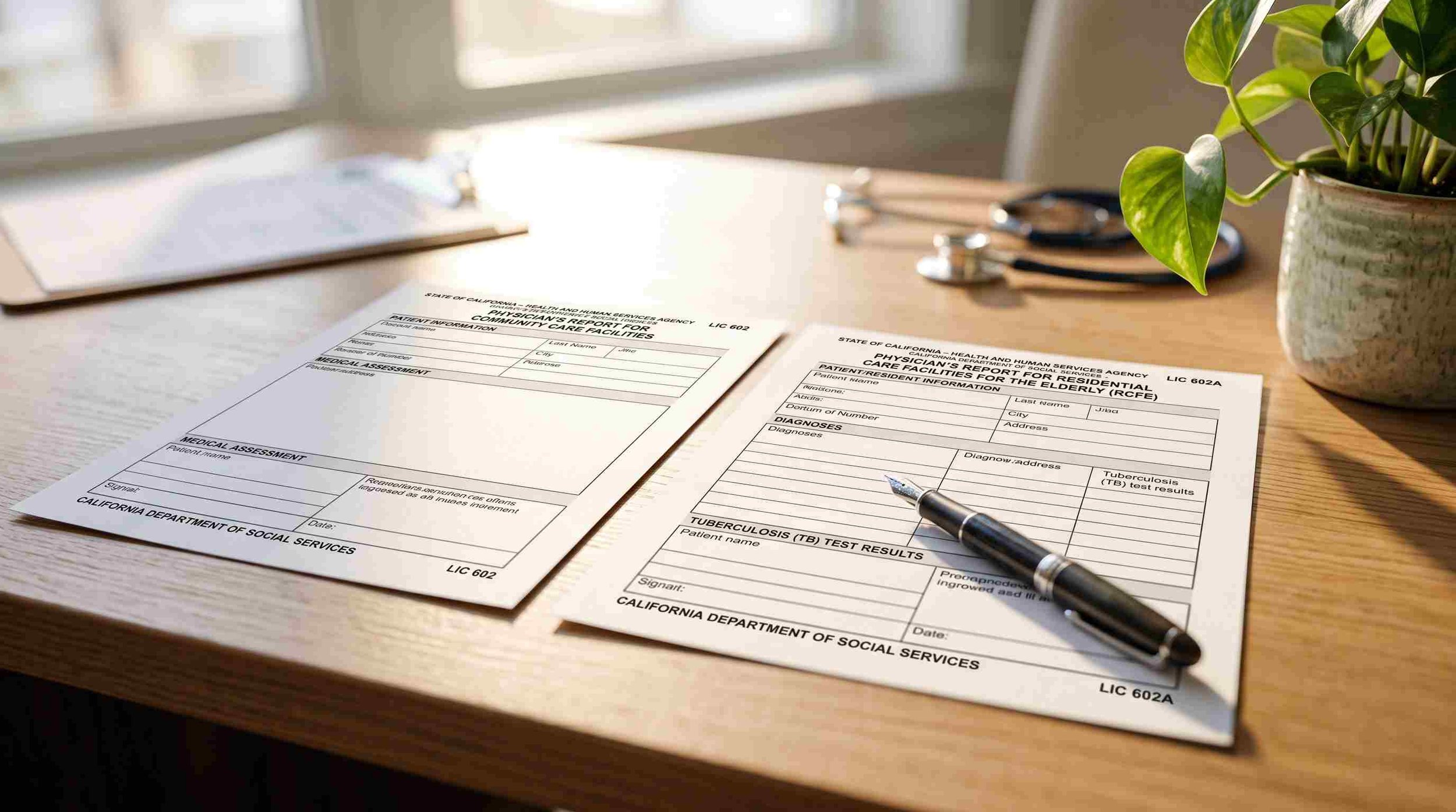
Ask which license type the facility holds. An assisted living home for the elderly needs the LIC 602A. Other community care facilities use the LIC 602.
The California Department of Social Services publishes both on its forms list, and the titles settle the question. LIC 602 (7/22) lists as the Physician's Report For Community Care Facilities and LIC 602A (4/26) as the Medical Assessment for Residential Care Facilities for the Elderly.
Families still get sent away with the wrong paperwork regularly, usually because a doctor's office keeps one of the two on file and hands it over without checking the license. The visit is wasted and the move-in date slips. What follows is how to tell the two forms apart, who fills in which part, and how to get the right one completed on the first try.
What Is the LIC 602 Form?
The LIC 602 is the physician's report used by community care facilities, which is the broad license category covering adult residential facilities, group homes and similar settings. Its full printed title is Physician's Report For Community Care Facilities, and the version on the state forms list carries a 7/22 revision.
Because the category is broad, the LIC 602 is the form a facility serving adults with developmental or psychiatric disabilities is likely to use, as well as some children's and short-term residential programs. The care setting is residential, but it is not licensed specifically for the elderly.
That distinction is the whole reason two forms exist. A facility is licensed under one category, and the medical paperwork it collects has to match that category rather than the age of the person moving in. An 80-year-old moving into an adult residential facility still goes through the LIC 602, because the form follows the building's license and not the resident's birthday.
What Is the LIC 602A Form?
The LIC 602A is the medical assessment for a Residential Care Facility for the Elderly, which is what most people mean when they say assisted living or board and care. The state forms list gives its title as Medical Assessment for Residential Care Facilities for the Elderly, with a 4/26 revision.
That revision date matters in practice more than it looks. A clinic working from an older printout may hand back a version the facility will not accept, so it is worth downloading the current file from the state forms page on the day it is needed rather than reusing a copy saved on someone's desktop last year.
Why Most Families Meet This Form
Scale explains why this is the form families meet most often. The National Institute on Aging (2023) describes board and care homes, also called residential care facilities, as small private facilities with 20 or fewer residents where staff are available around the clock, and notes that nursing and medical care are usually not provided on site.
Because clinical care is not provided in the building, the facility needs a clear medical picture before it agrees to admit anyone. The assessment is how an administrator decides whether a person's needs fit what a non-medical residential setting is legally allowed to handle. That is also why vague or half-finished answers get an application returned.
Which Form Does Your Facility Need?
Start from the license rather than from the brochure wording, because the brochure is marketing and the license is law. The table below pairs each form with the setting it belongs to and what it is actually for, so you can match it against what the facility told you.
| Form | What it is and where it is used |
|---|---|
| LIC 602 (7/22) | Physician's Report For Community Care Facilities. Used by community care facilities such as adult residential facilities and group homes. Completed by a physician and filed with the facility. |
| LIC 602A (4/26) | Medical Assessment for Residential Care Facilities for the Elderly. Used by RCFEs, the license category behind assisted living and board and care homes. The current revision is the one facilities expect. |
| LIC 603 (6/22) | Preplacement Appraisal Information. Not a physician's report. It records the appraisal of the person before placement, and it sits alongside the medical assessment rather than replacing it. |
If a facility representative cannot say which form they need, ask for the license number and the license category in writing. Both appear on the license posted in the building, and the category is what decides the paperwork. The National Institute on Aging (2023) suggests asking a health care provider which services are likely to be most helpful when you are unsure what level of care a person needs.
Why Does the Mix-Up Happen So Often?
Because the names differ by a single letter and the everyday words do not line up with the legal ones. Nobody introduces their mother's new home as a Residential Care Facility for the Elderly; they call it assisted living, or a care home, or a board and care. The form is filed under the legal name, and the two vocabularies rarely meet in the same conversation.
The Vocabulary Problem
Marketing language blurs the license lines even further. NCOA (2026) lists independent living, assisted living, continuing care retirement communities, and affordable senior apartments as separate housing options, and several of those are not licensed as facilities for the elderly at all, which means they do not use the LIC 602A.
So the useful question is never what kind of place is this. It is which license does this place hold, and the answer is a short phrase an administrator can give you on the phone. One sentence from them saves a second trip to the doctor and, more often than families expect, a week of waiting for the next open appointment.
The Filing-Cabinet Problem
Many clinics keep one blank form on hand because it is the one they are asked for most often. If the practice mostly serves adults in community care settings, that blank will be the LIC 602, and it gets handed to an assisted living family without a second thought by staff who are trying to be helpful.
Saying the exact form number when you book the appointment avoids this entirely. Give the number, the revision in brackets, and the facility type in one line, and the staff can print the correct file before you arrive. It is a small piece of preparation that removes the most common cause of a repeat visit.
Who Completes the Form, and Who Signs What?
A physician completes the medical assessment; the facility completes its own appraisal. These are two separate documents with two different authors, and families regularly assume the doctor handles both. When only one of them arrives, the facility cannot finish the file, and the application waits until somebody notices.
The medical side asks for diagnoses, functional ability, current medications, and whether any condition would be prohibited in a non-medical setting. The facility side records what the person needs day to day, which is the information staff use to build a service plan once someone has moved in.
The companion piece on two appraisals and two signers sets out how the LIC 602A and the LIC 603 divide that work, and why a facility cannot accept one in place of the other. Reading it before the appointment makes it easier to see which questions belong to the doctor and which belong to the facility.
Where Do Title 22 Rules Fit Into This?
Title 22 is the body of California regulation that sets out what a residential care facility for the elderly may and may not do, and the admission paperwork exists to satisfy it. These are not internal house rules that can be waived for a family in a hurry, which is worth knowing before anyone tries to negotiate the requirement away.
The state publishes the regulation text by article. CDSS lists the rules for these facilities on its Residential Regulations page as Title 22, Division 6, Chapter 8, split across articles 1 through 15, which is where an administrator's answers are coming from when they cite a rule.
Reading the regulations end to end is heavy going and rarely necessary for a family. What is worth knowing is that an administrator refusing to admit someone on medical grounds is usually pointing at those articles rather than at a personal preference, which is also why a cleanly completed assessment carries real weight.
What Health Checks Does an RCFE Expect Before Move-In?
Alongside the medical assessment, an RCFE normally wants proof of a recent tuberculosis clearance and a record of vaccinations. These are separate items collected from separate places, and a missing TB result is one of the most common reasons a move-in date slips by a week or more.
The TB Clearance
Two kinds of tests are in common use, and either one may be ordered. The CDC (2024) describes a TB blood test and a TB skin test, and notes that a positive result means TB germs are present in the body, after which a provider runs further tests to tell inactive infection from active disease.
The CDC also lists employment, school, travel, and immigration health screening among the reasons a person may need a TB test even when they feel completely well. Residential care screening belongs to that same practical category, so a clear result is paperwork rather than a sign that anybody suspects illness.
Vaccination Records and Timing
Pull the immunization history together before the appointment rather than after it, because chasing a childhood record from another state is slow work. Our walk-through of the vaccines and health checks asked for before move-in covers what facilities commonly request and the order in which to collect it.
If dementia is part of the picture, the assessment needs to describe it in enough detail for the facility to decide safely. The piece on what the LIC 602A must show when a senior wanders explains which behaviours matter to an administrator and why vague wording gets applications sent back.
How Do You Get the Right Form Completed Without a Delay?
Book the appointment with the form number in hand and the facility's license category already confirmed. Almost every delay in this process comes from a missing administrative detail rather than from a clinical problem, and all of those details can be gathered in a single afternoon of phone calls.
A Short Sequence That Works
Ask the facility for its license number and license category in writing.
Confirm whether they need the LIC 602 or the LIC 602A, by number.
Download the current revision from the state forms page that day.
Gather the medication list, recent discharge paperwork, and the TB result.
Book a visit long enough for the doctor to complete the form, not a quick follow-up.
Ask the facility to confirm receipt and tell you if anything is incomplete.
Getting a physician to a frail person is its own obstacle, and that is where most families lose a week. A house call doctor can complete the assessment at home, which also means the person is seen in the setting the form is actually describing. There is also a request form for the LIC 602 when a facility has asked for that version specifically.
Placement advisers do this work daily and often know what a given facility will accept. Completely Senior LLC works on placement for assisted living, memory care, independent living and board and care communities across East Ventura County and the San Fernando Valley, which is the kind of local knowledge that stops a form being filled in twice.
For the medical visit itself, continuity helps. Dennis Stolpner, MD practices family medicine in Santa Monica, and a family physician who already knows the patient's history can usually complete an assessment faster than a clinic meeting them for the first time.
What Happens If the Wrong Form Is Submitted?
The facility sends it back, and the move-in date moves with it. Nothing worse than that usually happens, but the delay lands at the hardest possible moment, often while a hospital is pressing a family for a discharge plan and a room is being held somewhere else.
Rejections are rarely about the medicine. A missing signature, an outdated revision, a blank functional-ability section, or a form built for the wrong license category will each stop an application, and none of them require a new clinical opinion to fix.
Keep a scan of everything you submit, including the pages left blank. If the paperwork is questioned later, or the person transfers to a different facility, a complete copy saves repeating the whole exercise from the beginning. A phone photograph of each page before you hand it over is enough.
Does the Admission Agreement Depend on This Paperwork?
Yes, in the sense that the agreement sets out services and charges built on what the assessment describes. A care level recorded on the medical form often drives the monthly rate quoted in the contract, so the two documents are read together rather than one after the other.
That makes accuracy worth more than speed in one specific way. An assessment that overstates a need can push the quoted price up for no reason; one that understates it can lead to a change-of-condition dispute a few weeks after move-in, when everyone involved is already tired. Describe the person as they actually are.
Our breakdown of the admission agreement a facility hands over alongside the LIC 602A goes through the terms worth reading twice before anyone signs, including notice periods, rate increases, and what counts as a change in condition. Read it with the completed assessment next to you.
FAQ
Can a nurse practitioner complete the medical assessment instead of a physician?
Facilities differ on what they will accept, and the safest step is to ask the administrator before the appointment. Confirming in writing avoids a rejected form after the visit has already happened.
How long does a completed assessment stay valid?
Facilities generally want a recent assessment rather than one from months earlier, and some ask for a new one after a hospital stay. Ask for the facility's own cut-off when you request the form.
Does a change in health after move-in mean a new form?
Often it means a reappraisal rather than a brand-new medical assessment. A significant change in condition is usually reviewed by the facility, and a physician may be asked for updated information.
Is the same form used in every California county?
The forms are issued by the state, so the numbers are the same statewide. County copies and local handouts circulate too, which is why checking the revision against the state forms page is worth the minute it takes.
Who keeps the original once it is complete?
The facility keeps it in the resident's file, so hand over the original and keep a copy for yourself. Having your own scan is useful if a transfer or a dispute comes up later.
Can the form be completed before a facility has been chosen?
Partly. Medical records, the medication list and a TB result can all be gathered in advance, but the form itself follows the license category of the specific facility, so the final version waits for that decision.
Sources Used
How To Choose a Nursing Home or Other Long-Term Care Facility – National Institute on Aging (2023)
Long-Term Care Facilities: Assisted Living, Nursing Homes, and Other Residential Care – National Institute on Aging (2023)
Physician's Report – Community Care Facilities (2025)
LIC 602A Explained: Medical Assessment for RCFEs – CareMAR (2026)
Senior Housing Options: A Complete Guide – National Council on Aging (2026)
Testing for Tuberculosis – Centers for Disease Control and Prevention (2024)
RESIDENTIAL CARE FACILITIES FOR THE ELDERLY (RCFE) – HEALTH AND HUMAN SERVICES AGENCY DEPARTMENT OF SOCIAL SERVICES (2025)